
Phlebotomy Technician Program at Montes HealthCare College
Hands-on venipuncture training in Gardena — small classes, real draw chairs, and an externship where you perform 50 live draws before you finish.
Clock hours, start to finish. Three modules and a supervised externship.
Of our 2024 students who sat for the California certification exam passed on their first attempt.1
Students to instructor — in lecture and at the draw chair.
Supervised venipunctures you perform in externship before you're signed off.
Phlebotomists work in hospitals, outpatient labs, blood banks, plasma centers, physician offices, and mobile draw teams. It is a specialized clinical skill with a specific license attached to it in California — which is exactly why it's a real career and not a job you can be talked out of by a slow season.
The work is technical and it is human at the same time. You have to be precise with a needle, exact with labeling and handling, and calm with a patient who is nervous, dehydrated, elderly, or eight years old. People remember the phlebotomist who made it easy. Employers remember the one whose samples never get rejected.
Our Phlebotomy Technician Program is built for people who want into healthcare quickly — either as the career itself, or as the first credential on a longer clinical path.
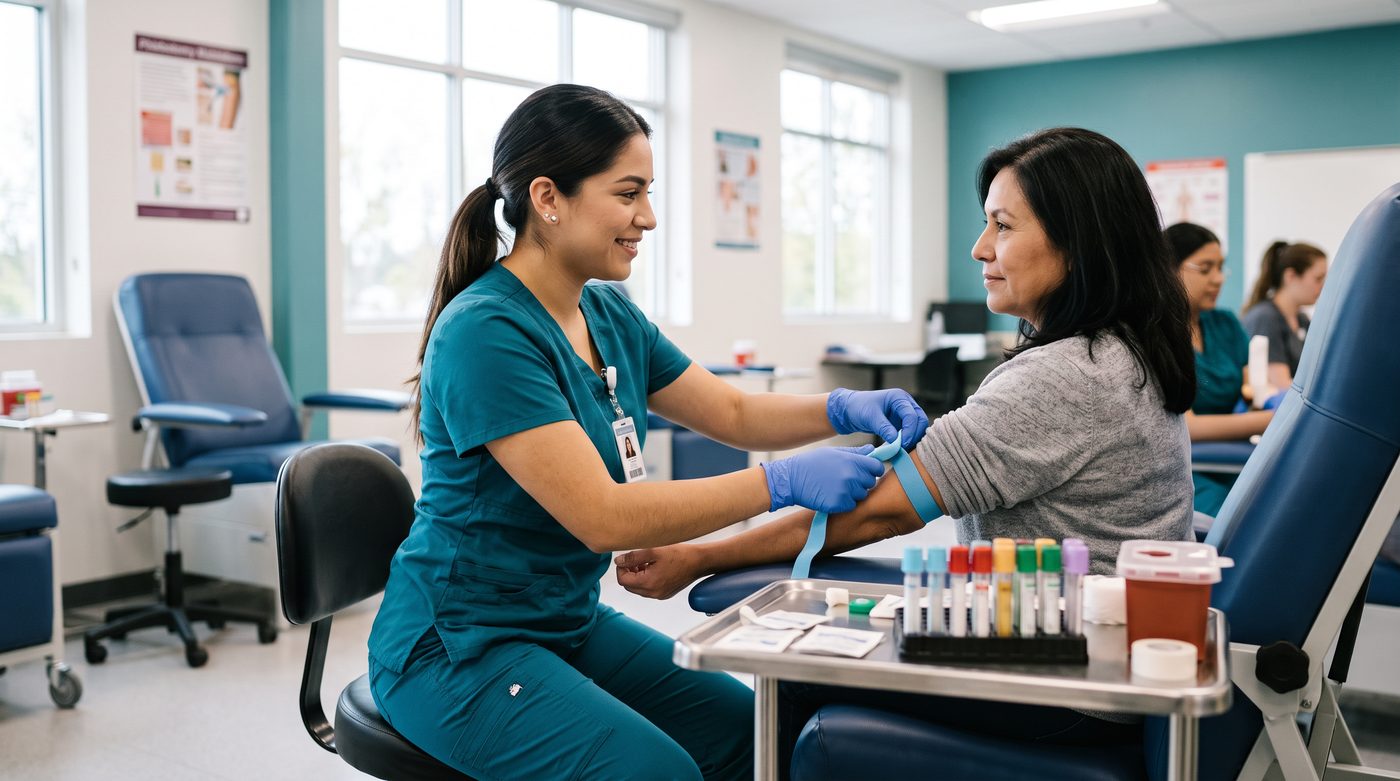
88 clock hours. 4 semester credits. Two classroom-and-lab modules, then you go to work under supervision.
Anatomy and physiology of the circulatory system, infection control and safety, equipment and tube selection, order of draw, patient identification, dermal puncture technique, and your first supervised venipunctures.
Difficult draws, special populations, specimen handling and processing, quality assurance, complications and how to respond to them, legal and ethical responsibilities, and exam preparation.
Supervised clinical hours at an approved externship site, where you complete 50 successful venipunctures and 10 successful skin punctures on real patients. MHCC arranges one externship site for you.
A lot of schools blur the line between finishing a program and holding a license. We won't. Here is the actual sequence in California, in order.
MHCC's job is steps one and two — and preparing you well enough that step three isn't the hard part.
This program requires a high school diploma or GED. Full requirements are listed further down the page.
You earn a Certificate of Completion from Montes HealthCare College.
The exam is administered by a certifying agency approved by the California Department of Public Health. Your training here is built around passing it.
The state issues the license, not the school. Prior misdemeanor or felony convictions may affect eligibility — talk to admissions early if that applies to you.
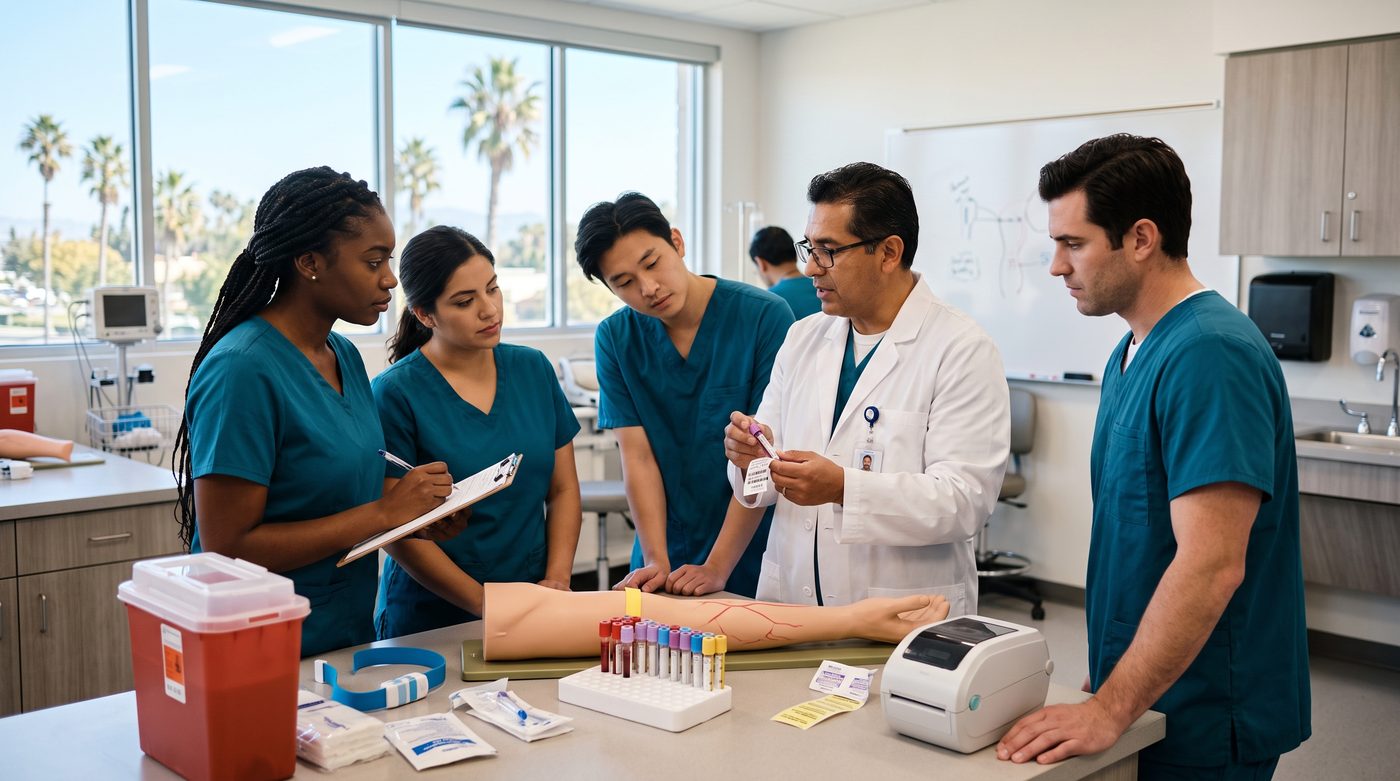
Phlebotomy is a motor skill. You do not learn it by watching a video — you learn it by doing it wrong a few times with someone experienced standing next to you, and then doing it right. That only works if the class is small enough for the instructor to actually reach you.
MHCC caps phlebotomy at fifteen students per instructor in both lecture and lab. Our clinical classroom has real blood draw chairs, exam tables, and the same equipment you'll handle on the job.
Your instructor, Manuel Hernandez, is a CPT II with twenty years in the field and twelve years teaching it. He has drawn from the patients you're going to be nervous about, and he'll tell you exactly how.
Career Services is available to MHCC students and graduates — resume help, mock interviews, and job search support in your field. We don't guarantee employment, and no honest school will. We do help you go after it.
These are complete numbers — tuition, registration, books, uniform, equipment, and exam materials are all included. What you pay depends on how you pay it.
Pay upfront
$1,950Your complete cost, everything included, after a $550 discount for paying upfront. The lowest total available.
Interest-free payment plan
$2,250Your complete cost, everything included, after a $250 discount — paid over time directly through MHCC with no interest.
Extended loan plan
$2,500Your complete cost, everything included, financed through a third-party tuition payment partner. An application fee and interest apply, and not all applicants qualify.
There is nothing to add on top. Registration, books, uniform, equipment, and exam materials are already inside the figures above, and your exact total is itemized in writing on your enrollment agreement before you sign anything.
If you've been performing phlebotomy at work — as a medical assistant, in a lab, in a clinic — California allows that documented experience to shorten your training. You may not need the full program.
With 40 or more hours of on-the-job phlebotomy experience in the last five years, you may only need the two classroom modules and can skip the externship. With 1,040 or more hours, you may only need the advanced module.
You'll need a completed CDPH Letter of Phlebotomy Experience from your employer. Mention your hours on the form and admissions will tell you exactly where you land.
No diploma or GED? Our Medical Assistant program doesn't require one. Ask admissions — there's usually a path.
88 clock hours total, including your externship. How that spreads across a calendar depends on the schedule you enroll in. Submit the form and admissions will send you the current schedule options and the next start date.
Most of our students are between 22 and 35, and plenty are older. This is an adult program built for people with jobs, kids, and rent — not for eighteen-year-olds fresh out of high school. You will not be the only one starting over.
The entrance test is a basic skills assessment, not an academic exam. And the bulk of this program is physical practice, not lecture. If you can follow a careful procedure and stay calm around people, you can learn this.
You earn a Certificate of Completion from MHCC. Certification as a Certified Phlebotomy Technician I is separate: you sit for an examination through a CDPH-approved certifying agency, then apply to the California Department of Public Health for your license. The program prepares you for that exam — the state issues the credential.
Most students are, at first. You start on equipment and technique long before you get to a live draw, and by the time you're in externship the nerves have usually turned into focus. Being careful is an asset in this job.
Possibly — but it depends. Prior misdemeanor or felony convictions can affect your eligibility for CDPH licensure, and that decision belongs to the state, not to us. Tell admissions up front so you get a straight answer before you spend money.
Yes. MHCC offers an interest-free payment plan directly through the school, and an extended loan plan through a third-party tuition partner. Admissions will walk you through both and show you the itemized total before you commit.
555 W. Redondo Beach Blvd., Suite 108, Gardena, CA 90248 — convenient to the South Bay, Torrance, Carson, Compton, Inglewood, and greater Los Angeles.
Send us your information and an admissions advisor will get you the schedule, the itemized cost, and honest answers about whether this is the right move for you.